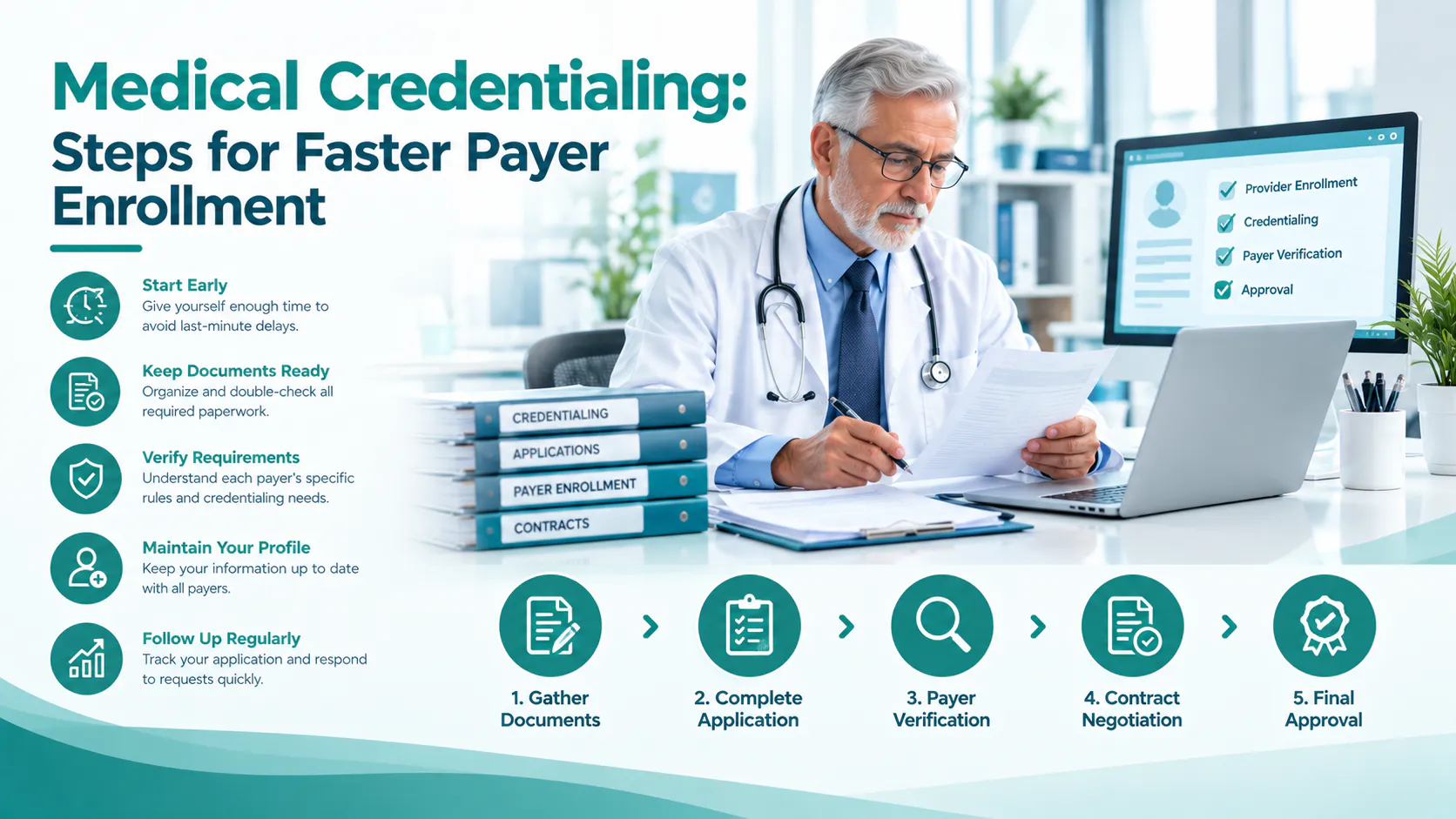
Medical credentialing is a critical step for any healthcare provider who needs to participate in insurance networks and bill payers for patient services. Before a new provider can reliably generate insurance revenue, the practice must complete enrollment requirements, submit supporting documents, and receive approval from the appropriate payers. A well-organized provider enrollment process can help reduce avoidable delays and keep applications moving.
1. Gather All Required Documents First
The credentialing process starts with collecting complete and current provider information. Common requirements include a state medical license, DEA registration, malpractice insurance certificate, board certification, medical school diploma, residency or fellowship completion letters, work history, references, and an NPI number. Every document needs to be current and unexpired.
Missing or expired documentation can place an application on hold or require information to be submitted again. Creating a document checklist before applications are submitted helps prevent these avoidable problems. Practices should also keep copies of credentialing documents organized so updates can be made quickly when a payer requests additional information.
2. Complete and Maintain the CAQH Profile
CAQH is an important part of commercial payer credentialing because many major payers use information from the CAQH database during the enrollment process. A complete profile should contain accurate provider information, professional history, licenses, certifications, insurance details, and supporting documentation.
Keeping the profile current is just as important as creating it. The Netix credentialing process includes CAQH setup, document uploads, attestation, and tracking of the required re-attestation cycle. An outdated or inactive profile can create problems when commercial payers attempt to verify provider information.
3. Submit Medicare and Medicaid Enrollment Correctly
Medicare enrollment is handled through PECOS, with supporting documentation submitted as part of the application. According to the Netix process, Medicare applications may take approximately 60–90 days from receipt of a complete application, depending on the applicable Medicare Administrative Contractor.
Medicaid enrollment is different because each state has its own requirements, portals, documentation standards, and processing timelines. Some states also involve managed care organizations. Submitting the correct information through the appropriate enrollment pathway helps prevent unnecessary back-and-forth with the payer.
4. Prepare Separate Commercial Payer Applications
Commercial payers do not all follow exactly the same enrollment process. Applications may involve CAQH information or payer-specific forms and portals, depending on the insurance company.
For example, practices may need to enroll with Blue Cross Blue Shield, Aetna, Cigna, UnitedHealthcare, Humana, and regional commercial payers. Each application should be completed according to that payer’s specific documentation and formatting requirements.
Payer panel status should also be checked before enrollment begins. A panel may be open or closed depending on the specialty and geographic market. Identifying panel availability early can prevent a practice from spending time on an enrollment application that cannot currently move forward.
5. Follow Up on Every Open Application
Submitting an application is not the end of credentialing. Follow-up and tracking are important because payer credentialing departments can have significant application volumes and long processing queues.
The Netix process calls for weekly follow-up on open applications through credentialing department calls, portal status checks, and escalation when applications stall. A status dashboard can also show each provider, payer, application stage, and current status in one place.
Commercial payer applications may commonly take around 60–120 days when complete, while the overall timeline depends on the payer and application. Consistent follow-up helps identify missing information and unresolved issues instead of allowing an application to remain unnoticed.
6. Pay Attention to Specialty and Location Requirements
Credentialing becomes more complicated when providers work across multiple locations or specialties. A provider may be enrolled with a payer at one practice location but still require additional enrollment or updates for another location.
This is particularly important for high-volume practices such as urgent care billing, where payer panel enrollment and credentialing status need to be verified before claims are submitted. Group practices should also make sure individual providers are correctly linked to the organization and that the group NPI billing configuration is accurate for each payer.
7. Confirm Approval and the Effective Date
Payer approval should be documented carefully. An approval letter contains an effective date, which determines when the provider can bill that payer. The effective date is not necessarily the same as the date the approval letter is issued, so practices should verify and record the actual effective date.
Once enrollment is approved, the provider’s NPI and payer enrollment information should be correctly linked within the practice management or billing system. This billing activation step helps ensure claims are routed under the appropriate provider and payer relationship.
8. Track Re-Credentialing and Revalidation
Credentialing does not end after the initial approval. Providers must continue meeting payer requirements and complete re-credentialing or revalidation before deadlines.
The Netix process tracks commercial re-credentialing deadlines and Medicare revalidation requirements, with updated documentation submitted before expiration. Keeping these dates on a centralized tracking system can help prevent an otherwise credentialed provider from losing network status because a renewal deadline was missed.
Build a Credentialing Process That Keeps Moving
Faster payer enrollment is not simply about submitting applications quickly. It depends on having complete documentation, accurate CAQH information, correctly prepared payer applications, regular follow-up, and clear tracking from submission through approval.
For practices adding providers, opening new locations, or establishing a new practice, a structured credentialing workflow can make the enrollment process easier to manage. Netix Medical Billing handles credentialing and provider enrollment from CAQH setup through payer applications, follow-up, approval confirmation, and billing activation.