
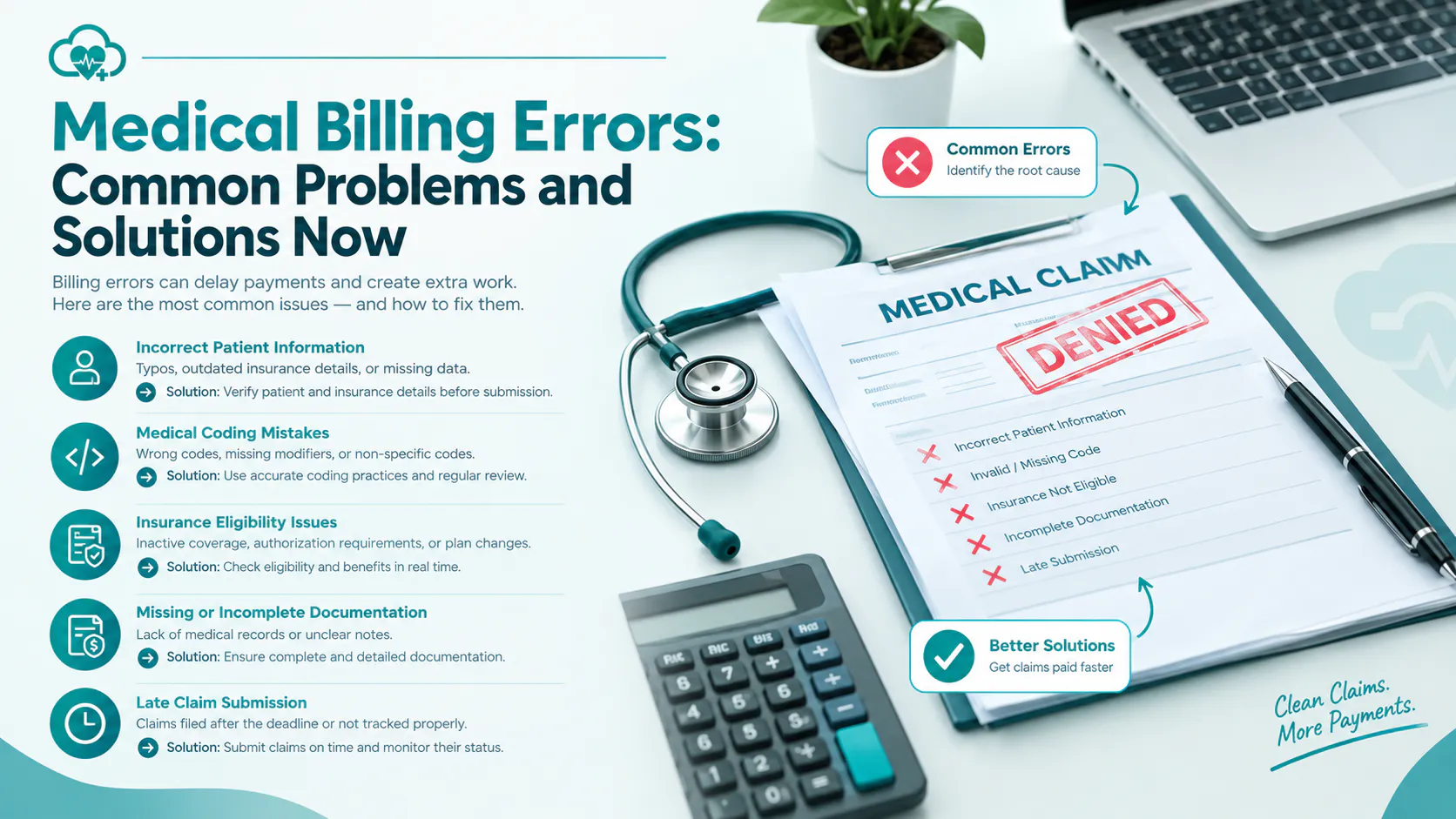
Medical billing errors can quietly reduce the amount a practice collects from the care it provides. A claim may be submitted with an incorrect CPT code, a required modifier may be missing, or a claim may simply be submitted too late. Individually, these problems may appear small, but repeated errors can create denied claims, delayed payments, and growing accounts receivable.
The good news is that many billing problems can be identified by looking at where errors occur in the revenue cycle. Accurate coding, timely claim submission, eligibility verification, denial follow-up, and consistent accounts receivable management all play a role in keeping revenue from slipping through the cracks.
Incorrect CPT Coding
One of the most common sources of medical billing problems is incorrect coding. The CPT code submitted on a claim needs to accurately represent the service documented by the provider.
When the wrong code is selected, the claim may be denied, delayed, or reimbursed incorrectly. Coding problems can also contribute to underbilling when a service is reported at a lower level than the documentation supports.
A consistent coding review process can help identify incorrect code selection before claims reach the payer. Practices should also review recurring coding-related denials to determine whether a particular error is happening repeatedly.
Accurate medical billing and coding provides the foundation for cleaner claims and more consistent payment.
Missing or Incorrect Modifiers
Modifiers provide additional information about how a service was performed or billed. When a required modifier is missing or used incorrectly, a claim can encounter payment problems or bundling-related denials.
The client’s service material specifically highlights modifier management as an important part of preventing avoidable billing problems. For example, urgent care billing may require careful use of modifiers such as modifier 25 when a significant, separately identifiable E&M service is performed alongside a procedure.
The solution is not to add modifiers automatically. Instead, modifiers should be applied when the documentation and billing circumstances support their use.
Undercoding Can Reduce Revenue
Not every billing error results in a denial. Some errors reduce the amount a practice receives without immediately drawing attention to the problem.
Undercoding is one example. The client’s medical billing and coding material notes that physicians may sometimes default to lower E&M levels because of concerns about audit risk. When documentation supports a higher level under the applicable coding framework, consistently reporting a lower level can result in lost revenue across many encounters.
Regular coding review can help practices identify patterns of undercoding while maintaining appropriate documentation and compliance.
Late Claim Submission
Even a correctly coded claim can create a revenue problem when it is submitted late.
The client’s site content identifies claims submitted within 24–48 hours of the encounter as a target. Faster submission gives the claim more time to move through adjudication and reduces the risk of unnecessary delays.
Late submission can also become particularly problematic when a claim needs correction or appeal because payer filing deadlines create a limited window for action.
A reliable billing workflow should therefore make timely charge entry and claim submission part of the standard process rather than something handled only when staff have extra time.
Eligibility Problems
A practice can provide a service correctly and still face a payment problem if the patient’s insurance information is inaccurate or coverage is inactive.
Eligibility verification should take place before or around the time of the visit so that coverage, benefits, and relevant requirements can be identified before the claim reaches the payer.
The client’s eligibility service material describes problems such as inactive insurance, different plans, and services that may not be covered under a patient’s benefits. Identifying these issues earlier can prevent avoidable billing problems downstream.
Missing Prior Authorization
Certain services may require prior authorization. If the authorization requirement is missed, the resulting claim can become difficult to collect even when the service was clinically appropriate.
A better process identifies authorization requirements before the service is performed, obtains the necessary approval, and tracks authorization information through the billing workflow.
This connects front-end administrative work with back-end payment. When authorization information is not communicated across the revenue cycle, the practice can end up dealing with the problem only after the claim has already been denied.
Denied Claims That Are Never Worked
A denied claim does not automatically mean the revenue is permanently lost. Depending on the denial reason, a claim may need to be corrected, resubmitted, appealed, or investigated further.
The problem occurs when denied claims sit untouched.
The client’s denial management process categorizes denials within 48 hours, targets corrected claim resubmission within 48–72 hours, and prepares formal appeals within five business days of receiving the denial. A structured process like this helps keep denials from simply becoming aging AR.
For practices with recurring claim problems, denial management should also identify the root cause instead of correcting only individual claims.
Aging Accounts Receivable
Medical billing errors often become more visible when they appear in accounts receivable.
A claim that was incorrectly coded, submitted late, or denied because of an eligibility or authorization problem can remain unpaid and eventually move into older AR categories.
Practices should monitor their AR aging and prioritize claims based on factors such as timely filing deadlines, balance, and payer response patterns. This helps ensure that recoverable revenue receives attention before recovery opportunities become limited.
Consistent accounts receivable follow-up can also reveal which billing problems are creating the largest recurring balances.
Fix the Process, Not Just the Claim
Correcting an individual claim is important, but repeated errors require a broader solution.
For example, if the same coding issue appears across multiple claims, correcting each claim separately does not address the process that produced the error. Similarly, if eligibility denials continue to occur, the practice should examine how insurance verification is being handled before the visit.
This is where revenue cycle management becomes important. Billing, coding, eligibility, authorization, claims, denials, and AR are connected. A problem in one part of the process can create consequences somewhere else.
Building a More Accurate Billing Process
Medical billing errors are easier to control when practices consistently monitor the entire billing workflow rather than focusing only on unpaid claims.
A practical approach includes accurate CPT and modifier selection, timely claim submission, eligibility verification, prior authorization checks, systematic denial follow-up, and organized AR management. Practices should also review recurring errors and use that information to improve the process that caused them.
The goal is not simply to fix more billing errors after they happen. It is to identify patterns early, prevent repeat problems, and create a revenue cycle where claims move through the system with fewer avoidable interruptions.
For practices reviewing their Medical Billing and Coding Services, a detailed billing process review can help identify where coding, claims, denials, or AR are creating unnecessary revenue delays.