

Dermatology billing lives and dies on documentation depth. The difference between a paid claim and a denied one is often a single missing measurement, a wrong destruction method, or a cosmetic vs medical distinction that was never clearly documented. A practice can do everything clinically right and still lose revenue on every procedure day if the coding does not match the note.
That is what makes dermatology different from most specialties. Most specialties bill one problem per visit. Dermatology routinely bills several problems, on the same patient, in the same encounter, using the same small set of code families against different lesions. That density is why modifiers and documentation matter more here than in almost any other specialty.
Code descriptors in this guide are paraphrased, not reproduced from the CPT book. Confirm exact descriptors in the CPT Professional edition before submitting claims. Codes, coverage policy, and bundling edits change with annual code set updates, so treat this guide as a working reference, not a substitute for your current payer contracts and current year code sets.
Readers who want the service behind this guide rather than the coding detail can find it on our dermatology billing services page, which covers the same specialty from the practice side: lesion measurement, the CPT table, Mohs billing, and the free dermatology audit.
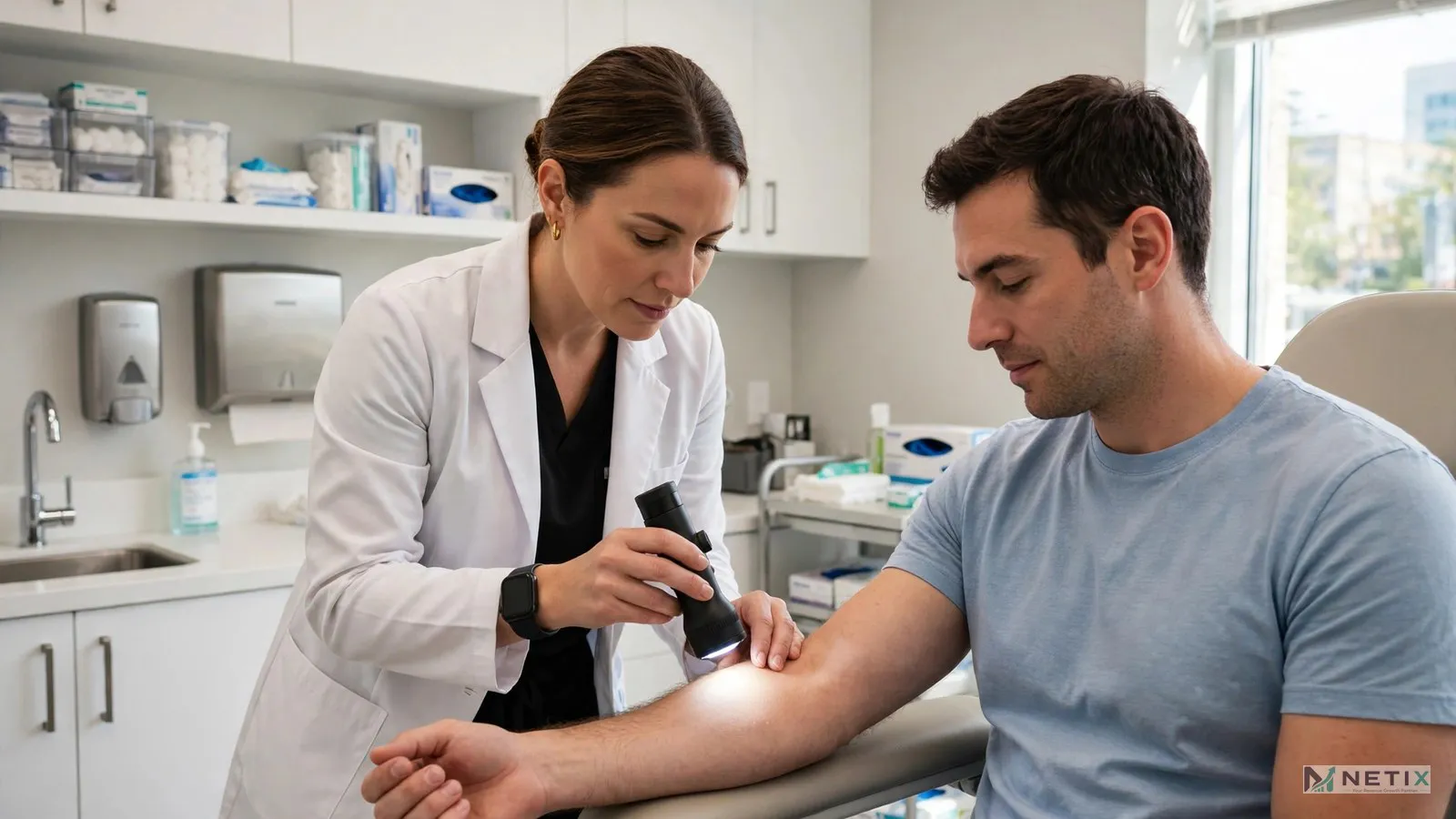
How Dermatology Coding Works: Four Families, One Visit
Dermatology revenue runs on four code families that stack on top of each other in a single visit: biopsy, excision, destruction, and Mohs. Each has its own size, site, and technique rules. On top of them sits an evaluation and management (E/M) layer that must be justified as separately identifiable every time it shares a claim with a procedure. Underneath them sits ICD-10 specificity, which decides whether a payer treats a lesion removal as medically necessary or cosmetic.
A single visit might include an E/M service for a rash, biopsies of three different lesions using three different techniques, and destruction of ten actinic keratoses. Nothing about that visit is unusual. What makes it hard to bill is that every lesion needs its own identity on the claim: its location, its size, its technique, and its diagnosis. A note that says “multiple lesions treated” does not support any of it. A note that names each lesion separately supports all of it. Almost every trap in this guide is a version of the same failure: the claim treats several distinct services as one vague service, or one service as several.
The Codes You Will Use Most (With 2026 Notes)
Biopsy codes (11102-11107)
Technique determines the code, not the lesion. Tangential, or shave, biopsy: 11102 for the first lesion, 11103 for each additional lesion. Punch biopsy: 11104 for the first lesion, 11105 for each additional lesion. Incisional biopsy: 11106 for the first lesion, 11107 for each additional lesion.
The technique must be documented explicitly. A note that only says “biopsy performed” does not support the code choice, because the payer cannot tell which technique was used. Incisional biopsy carries higher reimbursement than tangential biopsy, which is exactly why technique documentation is an audit point.
One bundling rule matters here. A biopsy of the same lesion that is then definitively treated in the same encounter is generally included in the treatment code, not billed separately. A biopsy is separately reportable when it is performed on a different lesion from the one being treated. In a multi-lesion visit, that distinction is the whole ballgame.
Shave removal codes (11300-11313)
Shave removal is not excision and not biopsy. It removes a lesion by shaving, without full thickness excision, and it is coded by anatomic site and lesion diameter. The common error is confusing shave removal with excision coding. If the note describes full thickness removal with margins, it is an excision, not a shave removal. The technique in the note decides the family.
Excision codes, benign (11400-11446) and malignant (11600-11646)
Excision codes are selected by two things: lesion diameter plus margin, and anatomic site. The site groupings are the same for benign and malignant excisions. Trunk, arms, and legs: 11400-11406 benign, 11600-11606 malignant. Scalp, neck, hands, feet, and genitalia: 11420-11426 benign, 11620-11626 malignant. Face, ears, eyelids, nose, lips, and mucous membrane: 11440-11446 benign, 11640-11646 malignant.
The measurement rule is the single most revenue-impactful rule in dermatology coding, and it is misapplied in the direction of underbilling on a significant share of excision claims. Excised diameter equals lesion diameter plus the narrowest margin on each side, measured at the time of surgery, not from the pathology report. Example: a 1.2 cm lesion plus 0.4 cm margins on each side equals 2.0 cm excised diameter, and the code is selected on 2.0 cm, not 1.2 cm. Missing any of the three measurements (lesion diameter, margin, excised diameter) is a primary cause of excision denials. Lesions also shrink by the time pathology sees them, which is another reason the surgical measurement, not the pathology measurement, controls.
Benign versus malignant determination comes from pathology, not clinical impression. If pathology is pending, do not code malignant yet. Code on what is known, then correct the claim when pathology returns. Coding a malignant excision code with a benign diagnosis is one of the fastest routes to a diagnosis inconsistent with procedure denial.
Destruction codes
Destruction codes are chosen by lesion type, not by method. Electrosurgery, cryosurgery, laser, and chemical treatment all fall in this family, but the family is chosen by whether the lesion is premalignant, benign, or malignant. Premalignant lesions, principally actinic keratoses: 17000 for the first lesion, 17003 as an add-on for 2 to 14 lesions, 17004 for 15 or more. Benign lesions, excluding skin tags and cutaneous vascular proliferative lesions: 17110 for 1 to 14 lesions, 17111 for 15 or more. Malignant lesions: 17260-17286, by site and size. The lesion count thresholds are the trap. A note that does not state the count cannot support the code, and a count on the claim that does not match the count in the note is a denial waiting for a remittance.
Photodynamic therapy is a separate family, not destruction. When actinic keratoses are treated with a photosensitizing agent activated by a light source, that bills under its own codes, including 96567 for photodynamic therapy, not under 17000-17004. A practice offering both cryosurgery and photodynamic therapy for actinic keratosis needs coders who can tell from the note which modality was actually used.
Wound repair, phototherapy, pathology, injections, and E/M
Repair coding is based on complexity and wound length in centimeters. Simple repair: 12001-12021. Intermediate repair: 12031-12057. Complex repair: 13100-13160. For layered repairs, use the highest complexity code once per area. Repair codes matter twice in dermatology: after excisions, and after Mohs, where simple repairs are included in the Mohs procedure and intermediate, complex, flap, and graft repairs bill separately.
Phototherapy and laser codes live or die on diagnosis justification. Actinotherapy (UV light): 96900. Photochemotherapy (PUVA): 96910, 96912, 96913. Laser treatment for inflammatory skin disease: 96920 for under 250 sq cm, 96921 for 250 to 500 sq cm, 96922 for over 500 sq cm, with body surface area documentation as the key requirement. Photodynamic therapy: 96567. If the diagnosis does not justify the light or laser treatment, no code in this family will save the claim.
Pathology codes are 88304 (level III) and 88305 (level IV), plus 88312 for special stains and 88341 for immunohistochemistry. Bill these only when performed and documented, and never alongside Mohs procedures by the same physician: the tissue processing and interpretation performed by the Mohs surgeon are included in the Mohs codes.
Intralesional injections are 11900 for 7 or fewer lesions and 11901 for 8 or more. The count threshold is the trap, and a note that does not state the count cannot support the code.
Office E/M codes are 99202-99205 for new patients and 99211-99215 for established patients. In dermatology, E/M is billed only when the evaluation is separate from the procedure. Systematic undercoding of E/M is common, and so is overuse of modifier 25 without documentation. Both directions cost money, and the fix for both is the same: document the evaluation as its own work, or do not bill it.
Modifiers That Matter in Derm
Every modifier in this section answers one question: is this service genuinely separate from the other services on this claim, and can the documentation prove it? National Correct Coding Initiative (NCCI) bundling logic assumes that when the same or related codes appear together on one claim, they are usually describing one service reported twice. In dermatology that assumption is wrong more often than in almost any other specialty, because the codes really are describing different lesions. The modifier is the only place on the claim that carries that distinction, and it must be backed by documentation that names each lesion separately: location, size, and technique. A global note that says “multiple lesions treated” does not support it.
Modifier 25: separately identifiable E/M on the same day as a procedure
Modifier 25 is appended to the E/M code, not the procedure code. It requires distinct history, exam, or medical decision making beyond what is inherent to the procedure itself. An example that supports it: evaluating and documenting a second, unrelated skin concern at the same visit as a destruction procedure. An example that does not: a visit that starts and ends with “biopsy this lesion.”
Payers actively audit practices where modifier 25 usage exceeds specialty benchmarks, and routine use without per-visit documentation is one of the most reliably audited billing patterns in the specialty. For destruction plus E/M specifically, remember that destruction codes carry a 0 or 10 day global period, and the global surgery package already includes the E/M work directly tied to the decision to perform the minor procedure. The override is modifier 25 on the E/M line, not modifier 59 on the procedure. Reaching for 59 on this pair is a common and telling error.
Modifier 59 and the X-modifiers: distinct procedural service
Modifier 59 bypasses NCCI bundling edits when procedures that are not normally reported together are performed during the same session. The X-modifiers are more specific subsets: XE (separate encounter), XS (separate structure), XP (separate practitioner), XU (unusual non-overlapping service). Per CMS guidance, use the most specific X-modifier when one applies, and use 59 only when no X-modifier fits. In dermatology, XS covers most defensible unbundling, because the distinction is almost always anatomic: a different lesion at a different site. Routine 59 use without per-lesion documentation is an audit risk. Payers watch the append rate, not just the individual claim.
Modifier 51, 76, laterality, and global period modifiers
Modifier 51 is applied to the lesser procedure when multiple surgical procedures are performed during the same operative session, with the primary, highest value procedure listed first. It is about payment reduction for multiple procedures, not about proving distinctness, so do not confuse it with 59 or XS. Modifier 76 covers the same procedure repeated on the same day by the same physician, genuinely required rather than a continuation of the first attempt. Modifier 77 is the same scenario performed by a different physician, most often a covering provider later the same day.
RT (right side) and LT (left side) are required on paired anatomical sites. Digit modifiers (FA-F9 for fingers, TA-T9 for toes) matter on multi-site excision claims: without them, a payer cannot tell three separate procedures from one code billed three times. These are not optional detail. For the postoperative period, modifier 24 covers an unrelated E/M, modifier 58 covers a staged or related procedure, and modifier 79 covers an unrelated procedure. Getting these three confused is how a legitimate follow-up visit denies as included in the global package.
Worked example: one visit, several lesions, one claim
A patient comes in for evaluation of a rash. During the same visit, the dermatologist biopsies three separate lesions using three different techniques, and destroys ten actinic keratoses. When the documentation supports every piece, the coding looks like this:
| Service | Code | Why it bills |
|---|---|---|
| Evaluation of the rash, separately identifiable from the procedures | E/M code with modifier 25 (level by medical decision making or time, for example 99213) | The rash evaluation has its own history, exam, and decision making, distinct from the procedure work |
| Tangential biopsy, first lesion | 11102 | Technique documented as tangential, first lesion of that technique |
| Punch biopsy, separate lesion | 11104 | Technique documented as punch, first lesion of that technique, different lesion |
| Incisional biopsy, separate lesion | 11106 | Technique documented as incisional, first lesion of that technique, different lesion |
| Destruction of actinic keratoses, first lesion plus lesions 2 through 10 | 17000 plus 17003 | Premalignant family, count documented as 10, inside the 2 to 14 add-on band |
Now change one fact. Suppose the note does not support the rash evaluation as separate from the procedures, and reads as a workup of the lesions that were biopsied and destroyed, with no distinct evaluation of its own. Then the E/M comes off, and the claim loses that revenue legitimately. That is not a payer being difficult. That is the documentation failing the test the modifier exists to enforce. Two more cautions: if any biopsy was performed on the same lesion that was then destroyed in the same encounter, that biopsy is generally included in the destruction code, not billed separately, and this example works because every procedure addresses a different lesion. And if the destruction count in the note does not match the count on the claim, the destruction lines are exposed even when everything else is correct.
Mohs Surgery Billing Workflow
Mohs micrographic surgery is the highest value procedure in dermatology, and its billing is proportionally complex. It is also the highest scrutiny procedure family in the specialty, because the surgeon is also billing for acting as the pathologist on their own case. Mohs billing runs on two axes: location, which determines the base code pair, and tissue block count within each stage, which determines whether the add-on block code applies. Every code in the family requires the physician to personally map, section, and interpret the tissue. That is what separates Mohs from an excision with a separate pathology read.
| Code | What it reports | Location |
|---|---|---|
| 17311 | First stage, up to 5 tissue blocks | Head, neck, hands, feet, genitalia, and any location where surgery directly involves muscle, cartilage, bone, tendon, major nerves, or vessels |
| +17312 | Each additional stage after the first, same session, up to 5 tissue blocks per stage (add-on, cannot be billed alone) | Same locations as 17311 |
| 17313 | First stage, up to 5 tissue blocks | Trunk, arms, legs |
| +17314 | Each additional stage after the first, same session, up to 5 tissue blocks per stage (add-on, cannot be billed alone) | Same locations as 17313 |
| +17315 | Each additional tissue block beyond the first 5, within any single stage (add-on, usable with any of 17311-17314) | Any location |
A case is billed by location once. The anatomic site does not change mid-case, so a single encounter reports either the 17311/+17312 pair or the 17313/+17314 pair, never both. The one exception to watch for is genuinely separate lesions treated with Mohs on the same day, which are billed as separate cases with distinct site identification, not as one case switching families halfway through.
+17315 is counted per stage, not across the whole case. It only starts once a single stage’s block count passes five. A case with 4 blocks in stage 1 and 4 blocks in stage 2 bills no 17315 at all, even though the total is 8 blocks. This is the single most common Mohs arithmetic error, and it cuts both ways: practices overbill 17315 by summing across stages, and underbill it by missing a stage that genuinely passed five blocks. +17312 and +17314 are add-on codes and cannot be billed without their parent first-stage code on the same date of service. And if a separate pathologist reads the tissue, it is not Mohs billing at all: the surgical removal codes as an excision, and the pathology codes under the pathologist.
Worked example: three stages on the nose
| Stage | Tissue blocks examined | Codes billed for this stage |
|---|---|---|
| Stage 1 | 4 blocks | 17311 x1 (first stage, within the 5-block allowance) |
| Stage 2 | 7 blocks | +17312 x1 (additional stage) plus +17315 x2 (blocks 6 and 7, beyond the first 5) |
| Stage 3 | 3 blocks | +17312 x1 (additional stage, no +17315, under 5 blocks) |
Total for the case: 17311 x1, +17312 x2, +17315 x2. Note what did not happen: stage 1 and stage 3 did not contribute blocks toward a case total, and no 17315 was billed for them. The block count resets every stage.
The repair after Mohs, and the documentation every Mohs claim needs
The surgical repair of the Mohs defect is a separately billable service and one of the highest value add-ons in all of dermatology, with one exception: simple closure is included in the Mohs procedure and is not billed separately. Layered closure (intermediate 12031-12057, complex 13100-13160), adjacent tissue transfer or flap (14000-14350), and skin graft (15100-15261) are billed separately, with code selection based on defect size and closure type. Most practices bill the Mohs correctly but underbill or miss the repair entirely. This is the single largest Mohs revenue leak, and it is a documentation leak first: if the defect size and closure type are not in the operative note, the repair code cannot be supported no matter how good the surgery was.
The tissue processing and interpretation performed by the Mohs surgeon are included in the Mohs codes, not separately billable by the same physician. Billing separate pathology codes (88304, 88305) alongside Mohs by the same provider is a compliance error, not an aggressive billing choice. For every Mohs claim, the note must carry site, number of stages performed, tissue block count per stage, defect size, and method of repair. A Mohs operative note that omits the per-stage block count is not a minor gap. The block count is the billing.
Medical vs Cosmetic: Documentation That Protects You
This is the money section, and it needs a plain statement up front. What follows is documentation and coding practice, not legal advice, not compliance advice, and not a coverage guarantee. Payer policies vary, sometimes sharply, on exactly the procedures below. A procedure that one payer covers with the right documentation may be denied by another payer on the same documentation. Practices should confirm coverage rules with their specific payers rather than treating any example here as a promise.
The core rule is simple to state and hard to apply. Health insurance covers dermatology procedures considered medically necessary (treating a diagnosed condition, disease, or functional impairment) and does not cover procedures performed purely for appearance. The confusing part is that the exact same procedure code can fall on either side of that line depending entirely on the diagnosis and documentation behind it. A mole removal, an eyelid procedure, or a scar revision can be fully covered in one case and denied outright in another, using the identical billing code, purely because the underlying medical justification differs.

Botox. Usually cosmetic when used for wrinkle reduction, and patient-billed in that case. Medically necessary when documented for conditions such as chronic migraine, severe hyperhidrosis, or blepharospasm, with the matching ICD-10 diagnosis and documentation of the condition and prior treatment history. The diagnosis, not the drug, decides the outcome.
Laser treatment. Cosmetic when for skin rejuvenation or tattoo removal for personal reasons. Medically necessary when for actinic keratosis, rosacea, or vascular lesions with documented functional impact. The note must say what condition the laser treated and why that condition needed treatment, not just that a laser was used.
Mole removal. Cosmetic when for appearance improvement. Medically necessary when for an atypical nevus with melanoma risk, chronic irritation, or bleeding on contact, with documentation of the clinical concern. A mole that bleeds when clothing catches it, documented as such, is a different claim from a mole the patient dislikes in photographs, even when the procedure code is the same.
Chemical peel. Cosmetic when for enhancement. Medically necessary when for actinic keratoses, which are precancerous lesions, with lesion count and clinical appearance documented. The precancerous nature of the lesion is the medical justification, and it must be in the note, not assumed.
Scar revision. Cosmetic when for aesthetic improvement. Medically necessary when for a hypertrophic scar causing pain, restricted range of motion, or recurrent breakdown, with functional impact documented. Pain level, range of motion limitation, or breakdown frequency turns an aesthetic procedure into a functional one, but only if those facts are documented before the claim goes out.
A procedure performed for both medical and cosmetic reasons in the same session needs careful documentation separating the two. The medical component may be billable while the cosmetic component is patient-billed. Do not treat this as a simple rule, because payer policies on mixed sessions vary, and practices should confirm with their specific payers how a mixed session should be split and documented.
The documentation elements that defend a medical claim are: an ICD-10 diagnosis code that describes a medical condition, not a cosmetic concern (vague codes, such as neoplasm unspecified, cause denials faster than almost anything else, because they give the payer nothing to approve); functional impairment documentation, stated as facts about this patient (pain level, restricted range of motion, recurrent infection, bleeding, or occupational impact); failed conservative treatments with specific dates, doses, and outcomes, where applicable; a clinical guideline citation from the American Academy of Dermatology or an equivalent specialty society, where the appeal requires it; photos when appropriate; and a treatment plan that connects the diagnosis to the procedure. For every procedure: lesion size, exact anatomic location, number of lesions treated, procedure performed and technique used, whether the procedure is medically necessary or cosmetic, and pathology results when tissue is submitted.
When a payer reclassifies a medically necessary procedure as cosmetic, the winning appeal shows four things in order: a medical diagnosis code, functional impairment documentation, failed conservative treatments with dates and outcomes, and a guideline citation where applicable. Resubmitting the same claim with the same note and hoping for a different reviewer is not an appeal strategy, it is a delay strategy.
What not to do, stated plainly: do not bill cosmetic procedures as medical. That is not aggressive billing, it is a compliance exposure that triggers audits. Do not use vague diagnosis codes to get a cosmetic procedure through. Do not document medical necessity that is not clinically true. The goal is to get paid for legitimate medical work, not to reclassify cosmetic work. Practices that blur this line do not just risk denials. They risk the audit that reviews every claim in the pattern, not just the one that denied.
Top Derm Denial Reasons and Fixes
This section is organized by what to do, not just by what the code means. For each denial: what it means in dermatology specifically, what caused it, what documentation prevents it, and whether the fix is a corrected claim or an appeal. Our denial management guide covers the general denial loop behind these derm-specific fixes, from capture and categorization through correction, appeal, and root cause work.
CO-50: not medically necessary (the cosmetic reclassification)
The most common dermatology denial and the most appealed. In derm, it usually means the payer reclassified a procedure as cosmetic. Causes: vague diagnosis code, missing functional impairment documentation, no failed conservative treatment history. Prevention: medical diagnosis code, functional impact in the note, conservative treatment history. Fix: appeal with clinical documentation and, where applicable, a guideline citation. Do not just resubmit the same claim. A resubmission tells the payer nothing new, and it will deny again.
CO-97: bundled into another service
The service was included in the payment for another service already adjudicated. In derm, this is usually an NCCI edit: two codes on the same claim that the payer treats as one service. Causes: missing modifier 59 or XS on a genuinely distinct lesion, or a procedure that genuinely is part of another procedure, such as a simple repair bundled into Mohs. Prevention: correct modifier use with per-lesion documentation, and knowing which services are genuinely bundled. Fix: if the modifier was valid and documented, appeal with the documentation. If the service genuinely was bundled, accept it and fix the coding going forward. Appealing a genuine bundle wastes the appeal window on a claim that cannot pay.
CO-151: frequency or units exceeded
The information does not support this many services or this frequency. In derm, this hits destruction codes (lesion counts that exceed payer limits or do not match the note), intralesional injections (count thresholds), and re-treatment intervals (treating the same lesion again too soon). Prevention: lesion counts in the note that match the claim exactly, and awareness of payer re-treatment interval policies. Fix: correct the units and resubmit if the count was wrong, or appeal with documentation supporting the frequency if the count was right. The first question on a CO-151 is always whether the claim or the note is wrong, because the fix depends entirely on the answer.
CO-4: inconsistent modifier or procedure code
The modifier does not match the procedure code, or the procedure code does not match the diagnosis. In derm, this is usually a modifier 25 without supporting documentation, a modifier 59 where an X-modifier was required, or a procedure code inconsistent with the diagnosis, such as a malignant excision code with a benign diagnosis. Prevention: modifier rules applied per claim, not by habit, and diagnosis-procedure pairing checked before submission. Fix: correct the modifier or code and resubmit. This is a corrected claim, not an appeal, because the original submission itself was wrong.
CO-16: missing or insufficient information
The claim lacks information or has a submission error. In derm, this is most often a missing lesion measurement, missing lesion count, missing anatomic site, or missing technique documentation. Prevention: the documentation checklist from the medical vs cosmetic section, applied to every procedure, not just the ones that look risky. Fix: identify the missing element from the remittance advice remark code, add it, and resubmit. CO-16 is the most fixable denial in this list, which is also why it is the most embarrassing to repeat.
CO-197: authorization absent
Precertification, authorization, or notification was not obtained. In derm, this hits phototherapy, laser treatments, and some procedures that require prior authorization. Prevention: verify authorization requirements before the service, not after, and confirm current requirements per payer rather than relying on last year’s rules. Fix: request retro-authorization if the payer allows it, or appeal with documentation of medical necessity.
CO-11: diagnosis inconsistent with procedure
The diagnosis code does not support the procedure code. In derm, this is usually a benign diagnosis paired with a malignant excision code, or a cosmetic diagnosis paired with a medical procedure. Prevention: diagnosis-procedure pairing checked at charge entry, and pathology results reviewed before final code selection. Fix: correct the diagnosis or the procedure code and resubmit. Like CO-4, this is a corrected claim, not an appeal. The claim as submitted could not pay, because its own two halves disagreed.
Most dermatology denials trace back to three root causes: documentation that does not name each lesion separately, diagnosis codes that do not justify the procedure, and modifiers applied by habit rather than by documentation. Fix those three patterns and the denial rate drops across every code family at once. That is also why denial work cannot sit in a separate silo from coding work. The denial is usually the symptom. The note is usually the cause.
Denied claims that sit unworked do not stay denials. They age, and aged denied claims become accounts receivable problems. Our AR aging guide explains how aging buckets work and why a denial left past its appeal window stops being recoverable revenue and starts being a write-off. That clock is the reason denial work needs a deadline discipline of its own: appeal windows do not pause while a denial is being worked, and our timely filing limits by payer reference sets out how those windows differ by payer. Practices that want denials handled as a managed process rather than a monthly surprise can read about our denial management service and our accounts receivable recovery service for aged claims that have already crossed into AR.

Frequently Asked Questions
What is the difference between a biopsy and an excision in dermatology coding?
A biopsy removes a tissue sample for diagnostic purposes. An excision removes an entire lesion completely. They have distinct CPT codes and must never be coded interchangeably. Coding a complete excision as a biopsy, or vice versa, results in incorrect reimbursement and potential compliance exposure.
How do you code a Mohs surgery case with multiple stages?
Bill the first stage with 17311 for head, neck, hands, feet, and genitalia, or 17313 for trunk, arms, and legs. Bill each additional stage with the matching add-on code (+17312 or +17314). Bill +17315 for each tissue block beyond the first 5 within any single stage, counted per stage, not across the whole case.
When should modifier 25 be used in dermatology?
When a significant, separately identifiable evaluation and management service is performed on the same day as a procedure, and the documentation shows distinct history, exam, or decision making beyond what is inherent to the procedure. A visit that consists entirely of examining the one lesion that gets biopsied does not support modifier 25.
What is the difference between modifier 59 and modifier XS?
Both indicate a distinct procedural service. XS is more specific: it means a separate structure, which in dermatology almost always means a different lesion at a different site. Per CMS guidance, use the most specific X-modifier when one applies, and use 59 only when no X-modifier fits.
Is Botox covered by insurance?
Only when medically necessary and documented as such, for conditions such as chronic migraine, severe hyperhidrosis, or blepharospasm, with the matching diagnosis code. Botox for wrinkle reduction is cosmetic and is patient-billed, not submitted to insurance. Payer policies vary, so confirm coverage rules with the specific payer.
How is excision size measured for coding?
Excised diameter equals lesion diameter plus the narrowest margin on each side, measured at the time of surgery, not from the pathology report. All three measurements (lesion diameter, margin, excised diameter) should be in the clinical record. Missing any one is a primary cause of excision denials.
Can you bill pathology codes with Mohs surgery?
No, not by the same physician. The tissue processing and interpretation performed by the Mohs surgeon are included in the Mohs codes. Billing separate pathology codes alongside Mohs by the same provider is a compliance error.
Why do dermatology claims get denied as cosmetic?
Because the payer determined the procedure was performed for appearance rather than medical necessity, usually due to a vague diagnosis code or missing functional impairment documentation. The fix is an appeal showing a medical diagnosis, functional impact, and, where applicable, failed conservative treatments and a guideline citation.
Find Out How Much Revenue Your Dermatology Practice Loses Per Procedure Day
The free dermatology billing audit reviews your excision measurement process, destruction add-on capture, cosmetic denial patterns, Mohs repair billing, and E/M distribution, and shows you, in plain numbers, what every procedure day should be generating versus what it actually is. Report in 48 to 72 hours, reviewed by a real billing specialist, yours to keep whether you hire Netix or not.
If you are comparing vendors as part of fixing these problems, our guide to choosing a medical billing company sets out the benchmarks and red flags worth checking before you sign.