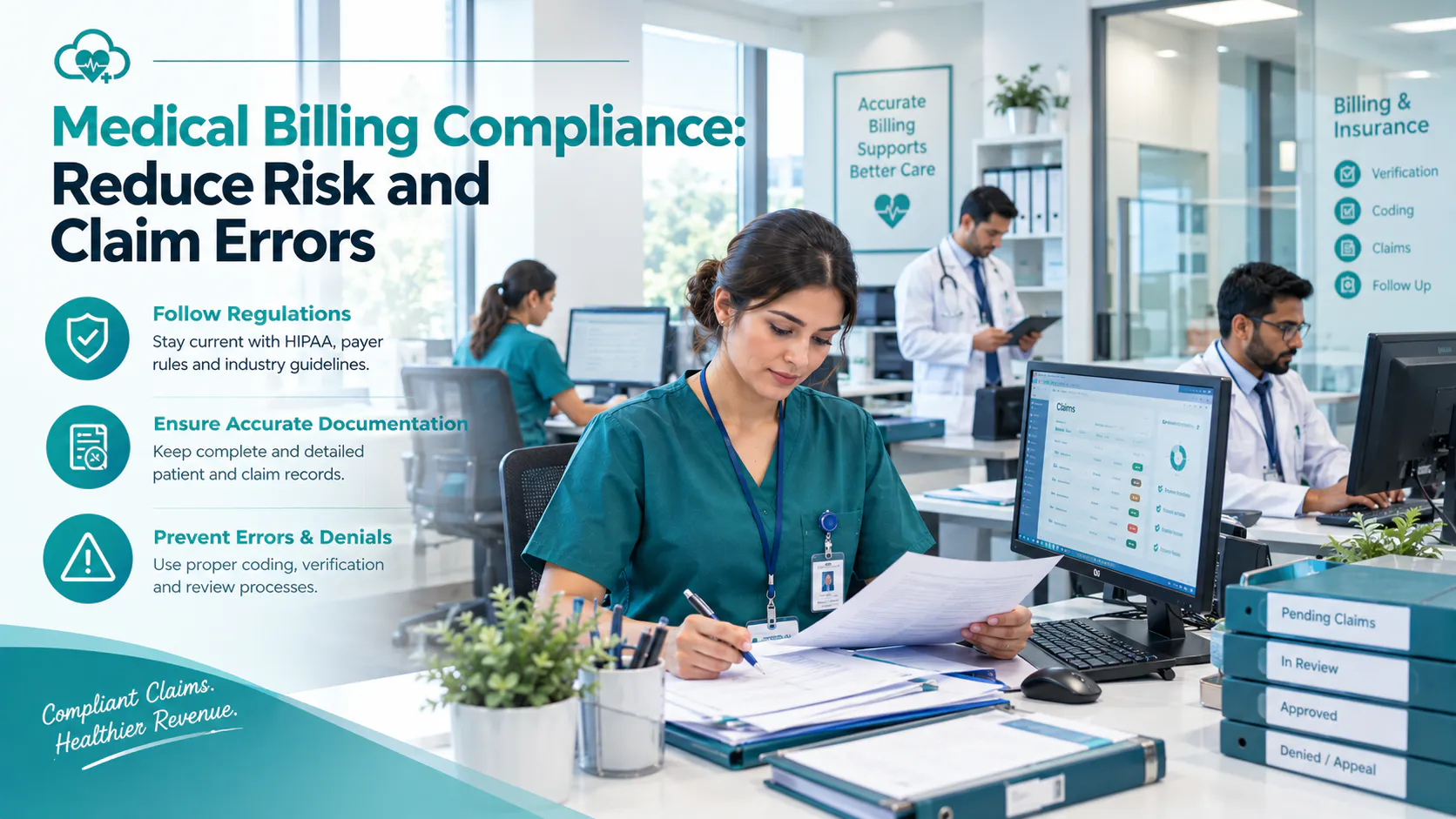
Medical billing compliance is about more than submitting claims on time. Every claim should accurately reflect the service provided, use appropriate codes and modifiers, include supporting documentation, and follow applicable payer requirements. When these steps are not handled consistently, practices can face claim errors, payment delays, denials, rework, and potential compliance concerns.
A structured medical billing and coding workflow helps reduce these problems before claims reach the payer. Accurate CPT and ICD-10 coding, appropriate modifier use, correct place of service, and pre-submission claim review can catch many common errors early. A consistent process also makes it easier to identify repeated mistakes instead of correcting the same issue on individual claims.
Why Billing Compliance Matters
Medical practices process a large number of claims, and even a small systematic error can affect many encounters. Undercoding can reduce legitimate reimbursement, while incorrect coding or unsupported services can create denial and audit risks. Other problems may come from incorrect patient information, eligibility issues, missing authorization, or provider enrollment gaps.
Compliance should therefore be treated as an ongoing process rather than a one-time review. Billing teams need clear procedures for coding, documentation, claim submission, payment posting, denial follow-up, and record keeping. Regular monitoring helps identify where the process is breaking down.
Accurate Coding Reduces Claim Errors
Coding accuracy is one of the foundations of compliant billing. The CPT and ICD-10 codes reported on a claim should correspond with the services documented in the patient’s medical record. The level of service should also be supported by the applicable coding guidelines and clinical documentation.
Modifiers and place-of-service codes require additional attention because a technically correct procedure code can still result in a claim problem when another claim element is incorrect. Pre-submission claim scrubbing can help identify missing modifiers, invalid code combinations, duplicate claims, and other issues before the claim is transmitted.
Documentation Should Support Every Claim
Clinical documentation provides the foundation for the services reported on a medical claim. The record should support what was performed, why it was medically necessary, and the level of service reported.
Documentation problems can become particularly important during payer reviews or audits. If the record does not support the code submitted, the practice may have difficulty defending the claim even when the service was actually provided.
Practices should therefore maintain consistent documentation and coding review procedures. When documentation and billing information match, it becomes easier to answer payer questions and address potential discrepancies.
Eligibility and Authorization Are Part of Compliance
Billing accuracy begins before the claim is created. Insurance eligibility should be checked before or around the time of the patient’s visit to confirm active coverage, benefits, copays, and other relevant payer information.
Authorization requirements should also be identified before services that require payer approval are performed. Missing an authorization can lead to a denial even when the procedure itself was medically appropriate.
For practices serving urgent care patients, this early verification is especially useful because high visit volume can multiply small administrative errors. Correct place-of-service reporting, eligibility verification, procedure coding, and modifier review should all be incorporated into the billing workflow.
Credentialing Can Affect Billing Compliance
Provider credentialing is another important part of the billing process. A provider may be fully qualified to treat patients but still face billing problems if enrollment with a particular payer is incomplete, expired, or incorrectly recorded.
New providers should be tracked from the beginning of the enrollment process, including required applications, payer follow-ups, and re-credentialing deadlines. Claims submitted before the provider is properly enrolled can create payment problems and may require significant correction work.
Keeping credentialing information current also supports cleaner claim submission. Billing teams should know which providers are enrolled with which payers and ensure claims are submitted under the appropriate provider information.
Claim Submission Should Be Consistent
Late or inaccurate claim submission creates another avoidable risk. Claims should be reviewed and transmitted promptly after the encounter so errors can be identified while the information is still readily available.
A consistent pre-submission review can check patient details, payer information, coding, modifiers, authorization status, and other claim elements. This reduces the chance that easily identifiable errors will reach the clearinghouse or payer.
Fast submission also leaves more time to correct rejected claims and address payer requests before filing deadlines become an issue.
Denial Management Should Find the Root Cause
A denied claim should not simply be corrected and forgotten. Denials can provide useful information about weaknesses in the billing process.
For example, repeated denials related to place of service may indicate a coding workflow problem. Repeated authorization denials may point to a gap in the scheduling or eligibility process. Credentialing denials can indicate that provider enrollment information is not being monitored closely enough.
A systematic denial management process should categorize denials, identify recurring causes, correct individual claims, and communicate upstream fixes to the appropriate team.
Regular Audits Strengthen the Billing Process
Internal billing reviews can help practices identify patterns before they become larger problems. A review may examine coding accuracy, documentation support, modifier use, eligibility verification, authorization records, credentialing status, claim turnaround, denials, and accounts receivable.
The purpose is not simply to find mistakes. It is to understand why they happened and improve the process that produced them. Tracking recurring issues by payer, provider, CPT code, or denial category can make these patterns easier to identify.
Build Compliance Into the Revenue Cycle
Medical billing compliance works best when it is integrated into the entire revenue cycle rather than handled as a separate task. Eligibility verification, authorization, documentation, coding, claim submission, payment posting, denial follow-up, and AR management all influence the accuracy and financial performance of a practice.
A consistent workflow gives billing teams multiple opportunities to identify errors before they become expensive problems. It also creates clearer documentation when a claim needs correction, appeal, or payer review.
For practices reviewing their overall billing operations, Netix Medical Billing connects coding, claims, credentialing, denial management, eligibility, and revenue cycle processes into one structured workflow.
The goal is to make accurate billing part of the daily process—not something addressed only after a denial, audit request, or payment problem occurs.